
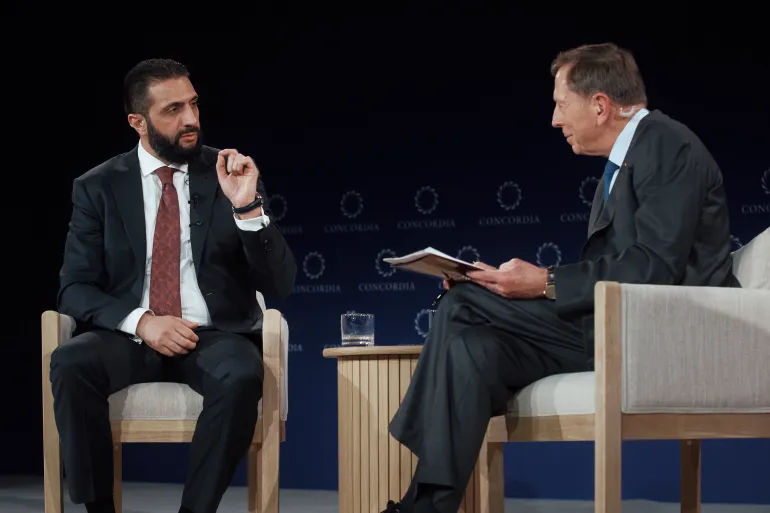


Photo: “Syrian President Ahmed al‑Sharaa, left, speaks with former US Army General David Petraeus during the Concordia Annual Summit in New York on September 22, 2025” (Andres Kudacki / AP)
In a striking twist of history, Syrian President Ahmed al-Sharaa and retired U.S. General David Petraeus shared a stage in New York this week, openly acknowledging the strangeness of the moment.
Al-Sharaa, who seized power in January after ousting Bashar al-Assad, once spent five years in U.S. custody under Petraeus’ command during the Iraq war. After his release, he founded the al-Nusra Front, later rebranded as Hayat Tahrir al-Sham (HTS). Once blacklisted as a terrorist group, HTS had its U.S. designation lifted in July, alongside the removal of a $10 million bounty on al-Sharaa.
Now recognized in Washington as Syria’s head of state, al-Sharaa is attending the UN General Assembly — the first Syrian president to do so in nearly 60 years. His delegation has already met with U.S. officials, including Secretary of State Marco Rubio.
“Just imagine you’re an American soldier,” one commentator said. “You fought in Iraq while hundreds were being killed or wounded each month, and now your commander is smiling across the table at the man who once led fighters against you.” Others expressed fear that this interaction is a prelude to tolerating further violence against minorities in the Middle East, especially Christians.
For some, the encounter is more than ironic — it brushes against U.S. laws that criminalize providing material support to terrorists. Under 18 U.S.C. § 2339B, knowingly aiding a designated foreign terrorist group can carry penalties of up to 20 years in prison. Yet the designation on HTS has been lifted, a reminder that in politics, yesterday’s enemy can quickly become today’s uneasy partner.