


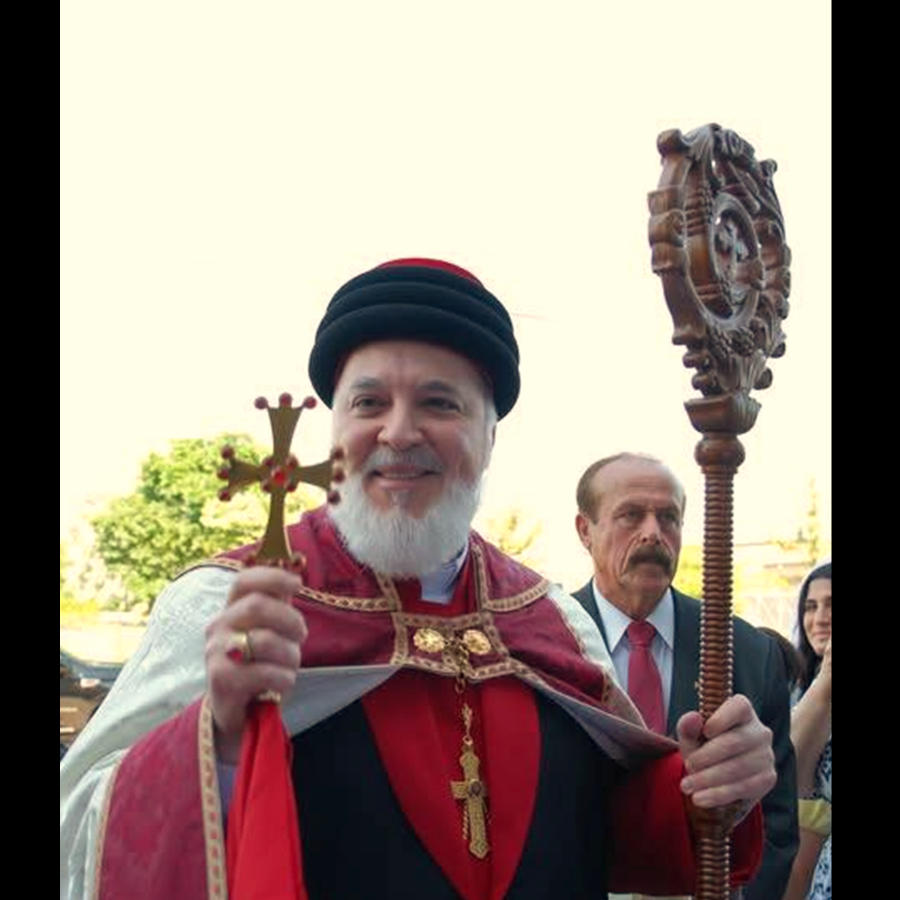
(photo courtesy of the Assyrian Church of the East)
From Erbil to California – Though his people and his Church are scattered across the far reaches of the world, their heart still beats in Assyria. There, where memory and faith converge, stand the enduring center. And there, unmistakably, is his homeland.
In January 2026, His Holiness Mar Awa III, Catholicos-Patriarch of the Assyrian Church of the East, undertook a consequential pastoral visit to the United States, spanning the major Assyrian centers of Chicago and California. The visit came at a moment of heightened sensitivity for Assyrians worldwide—caught between memory and survival, heritage and uncertainty—and underscored the Patriarch’s dual role as both spiritual shepherd and national moral authority.
Mar Awa III arrived in the United States shortly after presiding over a profoundly symbolic event in the Assyrian homeland: the groundbreaking and blessing of the Simele Massacre Memorial Complex in Simele, Duhok Governorate, on January 4, 2026. The ceremony, attended by senior Kurdistan Regional Government officials and representatives of the Assyrian nation, particularly from the United States, marked a long-awaited step toward public recognition of one of the defining traumas of modern Assyrian history.

In his address at Simele, the Patriarch spoke with clarity and restraint, thanking the regional authorities for their support, while reaffirming that the 1933 Simele Massacre, carried out by the Iraqi national army and their supporters, remains an open wound in the Assyrian conscience. True healing, he stressed, requires formal recognition by the Iraqi Parliament, a statement that placed historical memory squarely within the framework of justice and accountability.
It was from this solemn act of remembrance that Mar Awa III traveled to the diaspora, carrying with him not only the weight of history, but a message of continuity and renewal.
Chicago: Unity, Presence, and Ecclesial Confidence
The Patriarch’s visit to the greater Chicago area unfolded over several days and highlighted both the strength of the Assyrian Church of the East and its evolving relationship with sister churches.

On Sunday, January 11, 2026, the First Sunday of Epiphany, His Holiness presided over the Qurbana (Mass) at Mart Mariam Church in Roselle, joined by His Grace Mar Paulus Benjamin, Bishop of the Eastern United States, and His Grace Bishop Mar Ammanuel Yousip. The service, marked by solemnity and strong attendance, reflected the deep affection and legitimacy Mar Awa III enjoys among Assyrians in the diaspora.
During the same evening the Diocese of the Assyrian Church of the East in Chicago hosted a Patriarchal Dinner in his honor. The event brought together clergy, lay leaders, and community members, serving as both a celebration of unity and a forum for candid discussion about the future of the Church and the nation it serves.
Significantly, Chaldean Catholic priests were present at a related dinner hosted earlier in the week, signaling a quiet but meaningful spirit of fraternity among his people across ecclesial lines, an important gesture in a time when communal fragmentation remains a persistent challenge.

On Tuesday, January 13, 2026, Mar Awa III visited Mart Mariam Chaldean Catholic Church, where he was warmly received by Rev. Fr. Ayyad Khanjaro, along with Fr. Milan Kakony and Fr. Rodney Abbaso. Accompanying the Patriarch were Mar Paulus Benjamin, Archdeacon Gewargis Toma, and Deacons Gewargis Aziz and Dadway Daniel. The visit stood as a quiet but compelling affirmation that Assyrian Christian survival, both in the Middle East and the diaspora, depends on cooperation rather than competition.

California: Ordination and the Future of the Clergy
In California, the Patriarch’s visit took on a distinctly formative character. On Sunday, January 18, 2026, at Mart Mariam Church in Los Angeles, His Holiness elevated Reader Robert Khammo to the rank of Hopdyaqna, and Hopdyaqne Tiglat beth Yosip and Yosip Yaqo to the deaconate or Shamashoota. Following the ordination, Mar Awa III celebrated the Holy Qurbana, reinforcing the link between liturgical continuity and ecclesial growth.
These ordinations were not merely ceremonial. They pointed directly to one of the central purposes of the Patriarch’s American visit: seeking support to establish a school for priests in Erbil. The initiative reflects Mar Awa III’s long-term vision, rooted in scholarship, discipline, and theological depth, to rebuild clerical formation within the Assyrian homeland itself, rather than relying indefinitely on diaspora institutions.
A Revered Leader with National Legitimacy
Mar Awa III’s reception across the United States affirmed a reality that admirers recognize and realists cannot ignore: he is widely respected and deeply trusted, a leader whose affection for his people and Church is genuine and visible. He carries both spiritual authority and a measure of national legitimacy, speaking fluently in the language of tradition while remaining acutely conscious of contemporary constraints. Yet his leadership unfolds under severe and unrelenting conditions. At a moment when Assyrians confront demographic erosion, political marginalization, and persistent legal uncertainty across the Middle East, the Patriarch has emerged not as a savior untouched by limits, but as a rare unifying figure striving to hold together a fragmented nation with clarity, discipline, and resolve.
His January 2026 visit was not a ceremonial tour. It was a report to his flock, a call to responsibility, and an appeal for partnership, linking Simele to Chicago, Erbil to Los Angeles, memory to mission. In doing so, Mar Awa III reaffirmed a simple but enduring truth: the Assyrian Church of the East is not merely preserving a past, but deliberately shaping a future, one that demands faith, unity, and institutional strength in the interest of his nation and Church.
