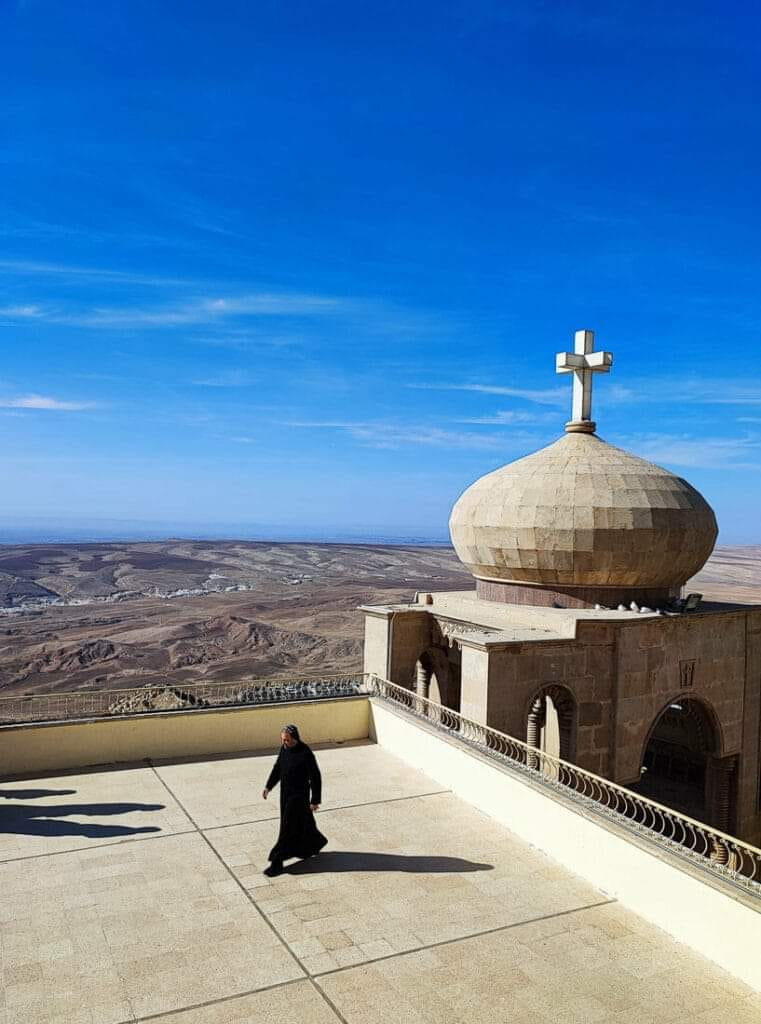
Baghdad, Iraq
April 27 2026
In January 2026, Iraq recorded over 8.53 trillion Iraqi dinars in revenue, approximately $6.5 billion, continuing a pattern of oil-driven fiscal strength. The Ministry of Finance data shows a modest year-over-year increase, with oil alone accounting for roughly 83 percent of total income. At the same time, expenditures reached 8.34 trillion dinars, largely absorbed by salaries, pensions, and social welfare.
These figures reveal a state that is solvent, but not yet strategic.
The central question is no longer whether Iraq has money. It is whether Iraq has vision.
A Reconstruction That Leaves People Behind
For Iraq’s indigenous Christians, the Assyrians, also known as Chaldeans and Syriacs, reconstruction remains incomplete, uneven, and in many places, illusory.
Their displacement is the result of cumulative historical trauma, from the Assyrian Genocide to the upheavals following the Iraq War and the genocidal campaign carried out by ISIS in 2014. Entire towns across the Nineveh Plains were emptied, their populations scattered across continents. While some physical reconstruction has occurred, it has not translated into sustainable return. Homes may be rebuilt, but without jobs, security, and long-term investment, communities remain fragile. Reconstruction without reintegration is not recovery. It is stagnation.
The Limits of an Oil State
Iraq’s dependence on oil is a structural constraint on its very essence. When 83 percent of national revenue derives from a single commodity, governance becomes reactive, tied to global price fluctuations rather than domestic priorities. This model leaves little room for targeted development, especially in marginalized regions like historically Christian areas. It also perpetuates a cycle in which state spending is consumed by immediate obligations rather than invested in long-term growth. If Iraq is serious about stability, it must diversify concretely.
Rebuilding Christian Areas as Economic Engines
The reconstruction of Christian areas should not be viewed solely as a humanitarian obligation. It is also an opportunity, one that Iraq has yet to seriously consider. The Nineveh Plains and surrounding areas are among the most historically and culturally rich in the world. Ancient Assyrian sites, early Christian monasteries, and living traditions rooted in millennia of continuity present a foundation for a robust tourism sector. Countries across the region have leveraged heritage tourism as a cornerstone of economic diversification. Egypt is a great example. Iraq, by contrast, remains largely absent from this opportunity, not because it lacks assets, but because it has not invested in making them accessible, secure, and marketable.
A serious national strategy could include:
- Developing pilgrimage and heritage tourism centered on historic churches and monasteries as well as Islamic shrines
- Restoring archaeological sites linked to ancient Assyrian civilization
- Building hospitality infrastructure; hotels, transport, guided services in historically Christian areas
- Partnering with diaspora communities and Assyrian or Chaldean chambers of commerce to promote cultural tourism
Such initiatives would do more than generate revenue. They would create incentives for displaced populations to return; not just to live, but to work, invest, and participate in rebuilding their communities.
Diversity as Economic Capital
The Chaldean Syriac Assyrians are not merely a vulnerable minority. They are a civilizational bridge connecting Iraq’s ancient past to its present.Their language, culture, and religious traditions are globally unique. In an era where cultural authenticity drives tourism and international interest, this heritage is not peripheral. It is economically valuable.
To neglect it is to discard a strategic asset. Iraq’s diversity should not be framed as a challenge to manage, but as an incredible potential to develop. A country that embraces its pluralism is not weaker but more attractive, and more connected to the world.
From Revenue to Strategy
The January surplus underscores an important fact: Iraq has the financial capacity to act.
Allocating a fraction of oil revenues toward:
- Comprehensive reconstruction of Christian areas
- Economic incentives for returnees as many Christian Iraqis are stranded in countries such as Turkey, Jordan, and Lebanon
- Development of tourism and service industries
Such acts would yield disproportionate returns; economically, socially, and politically.
This is not charity. It is statecraft.
A Test of Iraq’s Future
The fate of Iraq’s Christians is not an isolated issue. It is a measure of whether the Iraqi state can transition from short-term fiscal management to long-term national planning.
Can Iraq rebuild not just cities, but communities?
Can it move beyond oil toward a diversified economy?
Can it preserve the peoples who define its historical identity?
These questions are no longer theoretical. They are immediate and answerable.
If Iraq chooses to invest in its diversity and develop industries like tourism alongside reconstruction, it will not only bring back a people. It will rediscover itself and once again become the Cradle of Civilization.