
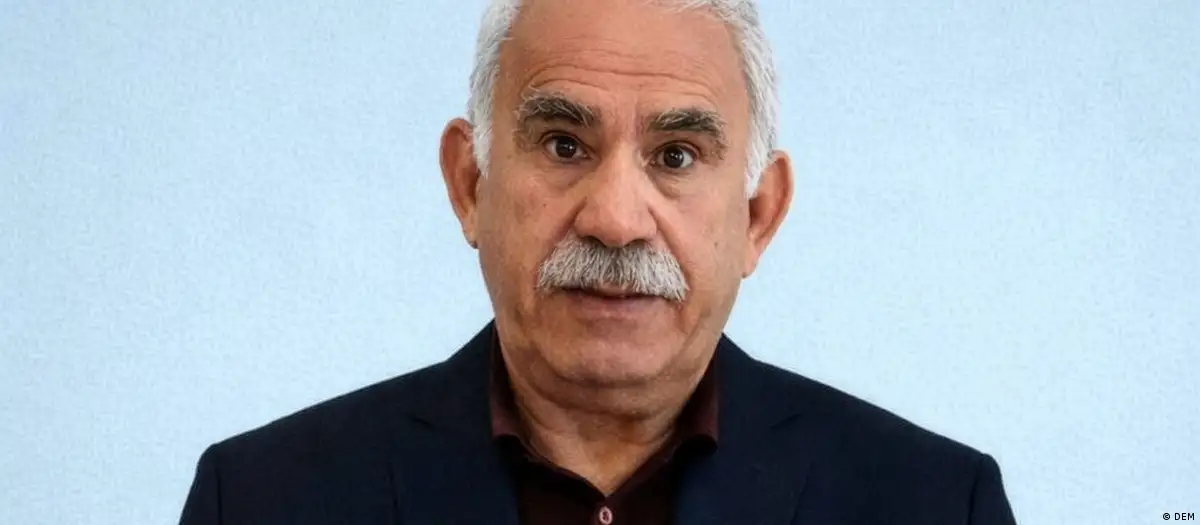

In the shifting landscape of Middle Eastern geopolitics—marked by war in Syria, instability in Iraq, and mounting tensions with Iran—the political thought of Abdullah Öcalan has re-emerged as a subject of serious discussion. His recent statements, delivered through intermediaries, articulate a sweeping vision: a “Middle Eastern Democratic Union of Nations” grounded not in state sovereignty, but in society itself.
This proposal is not merely Kurdish political theory. It is an attempt to redefine the organizing logic of the Middle East at a moment when both external intervention and internal authoritarianism appear increasingly exhausted. Yet its implications—particularly for vulnerable communities such as Assyrian and other Middle Eastern Christians—require careful scrutiny.
The Three Political Logics Shaping the Region
Öcalan’s analysis begins with a tripartite framework. He argues that the Middle East is currently structured by three competing “lines,” each representing a distinct political rationality.
1. The Interventionist Order: The U.S.–Israel Axis
Öcalan characterizes the first line as an interventionist system led by the United States and Israel. In his formulation, this axis seeks to reshape the Middle East through managed instability, leveraging conflict to dismantle resistant regimes and reconfigure regional balances of power.
Within this paradigm, minority groups—particularly the Kurds—are often treated as strategic instruments rather than genuine partners. The objective is not the realization of pluralistic democracy, but the construction of a geopolitical order aligned with security and economic interests.
2. The Status Quo: Nation-States and Managed Stagnation
The second line consists of entrenched regional states—Turkey, Iran, Syria, and Iraq—operating within a system inherited from the post-World War I order. These states, in Öcalan’s view, are defined by:
- केंद्रीकृत authority
- Assimilationist national identities
- Structural resistance to pluralism
He argues that these regimes maintain stability not by resolving underlying conflicts, but by freezing them—perpetuating Kurdish, Palestinian, and other minority questions as permanent crises.
For indigenous Christian communities, this system has proven equally corrosive. The collapse of pluralism under centralized nationalism has contributed to demographic decline, particularly in the aftermath of the Iraq War and the Syrian civil war.
3. The “Third Line”: Democratic Confederalism
Öcalan’s proposed alternative rejects both interventionism and nation-statism. Instead, he advances democratic confederalism, a model in which:
- Governance is decentralized to local councils
- Ethnic and religious communities self-organize
- State borders remain, but lose political centrality
In this vision, Kurds, Arabs, Turks, Persians, Armenians, and Assyrians coexist within a horizontal, society-driven political order. Rather than seeking an independent Kurdish state, Öcalan advocates a transformation of the region itself into a network of democratic societies.
He frames this as the only viable path out of what he describes as a prolonged “Third World War” unfolding across the Middle East.
Implications for Middle Eastern Politics
Öcalan’s framework, if taken seriously, carries profound implications.
A Post-State Political Imagination
First, it challenges the foundational assumption that the nation-state is the inevitable or desirable endpoint of political development in the Middle East. This is a radical departure from both Western policy frameworks and regional nationalist projects.
A Shift from Geopolitics to Sociopolitics
Second, it reorients political agency away from states and toward societal actors—local councils, civil organizations, and communal networks. In theory, this reduces the capacity of external powers to dominate the region through state-centric leverage.
A Reframing of the Kurdish Question
Third, it reframes the Kurdish struggle. Rather than pursuing statehood, it positions the Kurdish movement as a catalyst for regional democratization, seeking alliances with other marginalized groups.
The Unresolved Question: Minority Survival
Despite its conceptual appeal, Öcalan’s model raises a critical question: Can decentralized democracy protect the most vulnerable?
For Assyrians and other Christian communities, this is not a theoretical concern. It is an existential one.
These communities have endured:
- Genocidal violence, including the Sayfo
- Mass displacement in Iraq and Syria
- Ongoing demographic collapse due to emigration and insecurity
In such a context, the shift from centralized states to decentralized governance presents both opportunity and risk.
Opportunity
- Greater local autonomy could allow for cultural and linguistic preservation
- Community-based governance may enable more direct political participation
Risk
- Power may devolve to dominant local actors, marginalizing smaller groups
- Security vacuums could expose minorities to renewed violence
- Without enforceable guarantees, pluralism may remain aspirational
Toward a Viable Synthesis
If Öcalan’s “third line” is to move from theory to practice, it must be institutionally fortified, particularly with respect to minority protection.
A viable framework would require:
1. Autonomous Administrative Structures
Indigenous Christian regions—such as the Nineveh Plains—must have recognized local governance, including control over education, policing, and cultural institutions.
2. Binding Legal Guarantees
Pluralism must be codified through constitutional protections, not left to political goodwill.
3. Structured Power-Sharing
Minority communities require guaranteed political representation and decision-making authority, ensuring they are not subsumed by larger groups.
4. Security Mechanisms
Local self-defense forces, integrated into broader frameworks, are essential to prevent recurrence of past atrocities.
5. International Oversight
External guarantees—whether through multilateral agreements or monitoring bodies—are necessary to enforce compliance and deter violations.
Conclusion
Öcalan’s vision of a “Middle Eastern Democratic Union of Nations” is one of the most ambitious political proposals to emerge from the region in decades. It offers a compelling critique of both external intervention and internal authoritarianism, and it articulates a genuine aspiration for coexistence among the Middle East’s diverse peoples.
Yet aspiration alone is insufficient.
For Assyrians and other endangered Christian communities, the future of the Middle East will not be determined by ideology, but by structures of protection, power, and permanence. Any new political order—whether state-based or confederal—must be judged by a single standard:
Can its oldest and most vulnerable peoples survive within it?
If Öcalan’s third line can answer that question with concrete guarantees, it may indeed represent a path forward. If not, it risks becoming another vision in which the language of coexistence persists—while the communities it promises to protect continue to disappear.