
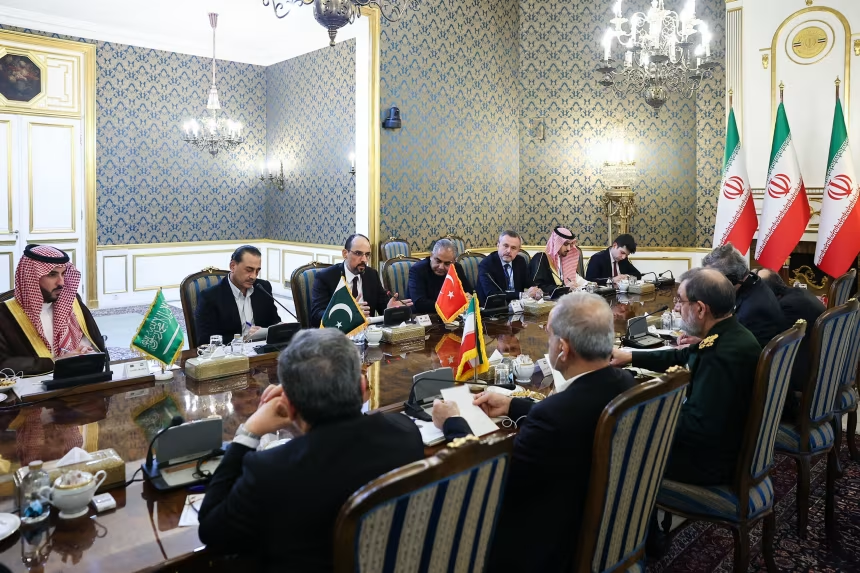

The October 26 Tehran meeting signals a possible shift toward regional responsibility for regional security. For the Chaldean Syriac Assyrians, the critical question is whether this emerging order will protect indigenous peoples or simply rearrange the balance of power among states.
A Significant Meeting in Tehran
On October 26, 2026, senior representatives of Saudi Arabia, Turkey, and Pakistan met with Iranian officials in Tehran in a significant diplomatic initiative aimed at containing an increasingly dangerous regional conflict. The meeting brought together Saudi Defense Minister Prince Khalid bin Salman, Pakistan's army chief Field Marshal Asim Munir, and Turkey's intelligence chief Ibrahim Kalin with Iranian President Masoud Pezeshkian and senior security officials.
The meeting comes amid escalating Houthi attacks against Saudi Arabia, continuing hostilities involving Iran, the United States, and Israel, and mounting fears that the region could be drawn into another phase of open warfare. The discussions addressed regional security and de-escalation, including the conflict in Yemen and efforts to prevent a renewed US-Iran confrontation. Qatar has also been involved in diplomatic efforts alongside Pakistan.
The immediate purpose of the meeting is not to bring Iran into the Mecca Joint Defence Agreement, established by Saudi Arabia, Turkey, and Pakistan in August 2026. Rather, the immediate challenge is to persuade Tehran to use its influence over Ansar Allah, commonly known as the Houthis, to help halt attacks that threaten Saudi security and regional stability.
The distinction matters. Three countries that have established a mutual-defence arrangement are now engaging directly with a regional power whose interests and alliances differ from their own. The emerging reality is that even states preparing for collective defence must negotiate with their adversaries if they hope to avoid a wider war.
Saudi Arabia and the Limits of Military Power
From Tehran's perspective, Saudi Arabia risks repeating a mistake made by Washington: becoming involved in a conflict without a clear, achievable strategy for bringing it to an end.
The conflict in Yemen has demonstrated the limitations of military superiority when political objectives remain unresolved. Saudi Arabia has spent years confronting the Houthis, yet the movement has retained substantial military capabilities and the ability to threaten critical infrastructure.
Iran's capacity to influence the Houthis gives Tehran leverage in its dealings with Riyadh. But influence should not be confused with complete control. The Houthis have their own political objectives, domestic constituencies, and strategic calculations. Any settlement will therefore require more than an understanding between Saudi Arabia and Iran.
One reported obstacle is the Houthi demand that Saudi Arabia lift restrictions on Yemeni air traffic before a cessation of hostilities. The distinction between restrictions on air traffic and maritime restrictions is important: they are separate issues, and an agreement addressing one does not necessarily resolve the other.
The immediate challenge is whether diplomacy can produce a mutually acceptable arrangement before further attacks, retaliation, and military mobilization make a settlement more difficult.
A Region Increasingly Taking Responsibility for Its Own Security
The Tehran meeting points toward a broader development in Middle Eastern geopolitics: regional powers are increasingly seeking to manage their own security problems through direct diplomacy, strategic partnerships, and regional mechanisms.
For decades, the United States has been the principal external military power shaping the regional security environment. Its alliances, military bases, arms sales, and interventions have influenced the calculations of governments throughout the Middle East.
However, American involvement has not eliminated regional rivalries, prevented repeated wars, or produced a durable regional security framework. The wars in Iraq, Syria, and Yemen, together with recurring confrontations involving Iran and Israel, demonstrate the limits of relying on external military power to resolve deeply rooted political conflicts.
As Washington reassesses its commitments and regional governments question the reliability and costs of external security guarantees, countries such as Saudi Arabia, Turkey, Pakistan, and Iran have stronger incentives to communicate directly and develop their own mechanisms for managing crises.
This does not mean the United States has become irrelevant or that its military presence is disappearing. Washington remains deeply involved in the current confrontation, and the Tehran meeting itself is taking place against the backdrop of continuing US-Iran tensions. Rather, the change is that regional governments are demonstrating greater willingness to act independently, even while American involvement remains consequential.
Nor does regional ownership automatically produce peace. States can make their own conflicts more destructive, pursue competing spheres of influence, and reach arrangements that protect governments without protecting the populations living under them.
The question is not simply whether the Middle East will become less dependent on Washington. It is what regional governments will do with the greater responsibility they are assuming.
What Does This Mean for the Chaldean Syriac Assyrians of Iraq?
For the Chaldean Syriac Assyrians, the consequences of this geopolitical transition are particularly important.
The Assyrians are an indigenous people of Mesopotamia whose historical, linguistic, cultural, and Christian heritage predates the modern states of the Middle East. Their present circumstances cannot be understood solely through the familiar language of religious minorities. They are also a people with a distinct historical identity, a living Syriac linguistic heritage, and an enduring connection to their ancestral lands.
Over the past century, massacres, persecution, forced displacement, emigration, and political marginalization have severely weakened their demographic presence in their homeland. Since 2003, insecurity, targeted violence, property disputes, demographic pressures, and the collapse of local communities have accelerated this decline. The 2014 ISIS assault on the Nineveh Plain was a particularly devastating episode in a much longer history of displacement.
The central danger is that the emerging regional security order may be negotiated almost entirely among states, with little consideration for the indigenous populations whose future depends on the outcomes.
For the Assyrians, three developments deserve particular attention.
First, regional stability could create an opportunity for the survival and reconstruction of historic communities. A reduction in conflict involving Iran, Iraq, Turkey, and their regional partners could improve the prospects for rebuilding towns, restoring property, encouraging displaced families to return, and preserving the remaining Assyrian presence in the Nineveh Plain and in other native Assyrian areas of Iraq.
Yet stability alone will not reverse demographic decline. Communities need security, functioning institutions, economic opportunity, and meaningful authority over local affairs. A region can be relatively peaceful while its indigenous population continues to disappear through emigration and structural marginalization.
Second, regional security arrangements could reinforce the existing political order without addressing its injustices. Governments naturally prioritize territorial integrity, strategic interests, energy security, and the survival of their political systems. The rights of smaller indigenous peoples rarely receive comparable attention unless those rights are deliberately incorporated into negotiations and domestic policy.
A new regional order that reduces interstate warfare but leaves the Assyrians politically marginalized, vulnerable to land appropriation, and unable to govern their local affairs would be an incomplete success.
Third, the Assyrian question must become part of the wider discussion about the future of Iraq. Iraq is not simply a geographic arena in which larger powers compete. It is the homeland of peoples whose security, rights, and political participation are essential to the country's long-term stability.
For Baghdad and the Kurdistan Regional Government, the obligation is clear: the survival of the Assyrians must be treated as a substantive political and constitutional issue, not merely as a matter of religious tolerance or cultural preservation.
Article 125 of the Iraqi Constitution provides for administrative, political, cultural, and educational rights for the country's Turkmen, Chaldeans, Assyrians, and other constituent groups. Its implementation should be a central priority. That means meaningful local administration, adequate public funding, representation in government, Syriac-language education and services, and effective local security arrangements.
Article 23(Third)(b), which prohibits property ownership for the purpose of demographic change, is also relevant to the protection of Assyrian lands and communities. Constitutional guarantees must translate into enforcement, restitution where appropriate, and protection against practices that undermine the demographic continuity of indigenous areas.
The Nineveh Plain should be central to this effort. Its future must not be determined exclusively by Baghdad, Erbil, or outside powers without the meaningful participation of the people whose historic homeland it is.
And What About the Assyrians of Iran?
The situation of the Assyrians in Iran presents a related but distinct set of concerns.
Iran has a longstanding Assyrian community, particularly associated with their native Urmia and Tehran. The community has preserved its language, religious traditions, and cultural identity despite substantial emigration and changing political circumstances.
Iran formally recognizes Assyrians and Chaldeans as religious minorities, and its constitutional framework provides for a reserved parliamentary representative for Assyrian and Chaldean Christians. This formal recognition is significant, but it should not be confused with comprehensive protection of every aspect of an indigenous people's collective identity, cultural autonomy, or political interests.
The current conflict introduces additional uncertainties. If hostilities intensify, minority communities may face greater economic insecurity, restrictions associated with wartime conditions, disruption of daily life, and increased pressure to emigrate. If diplomacy succeeds, a reduction in regional tensions could provide some relief.
However, the future of Iran's Assyrians will also depend on domestic political developments, the treatment of religious and ethnic communities, freedom to sustain cultural institutions, and the ability of younger generations to remain connected to their heritage.
A broader regional security framework should therefore be judged not only by whether Iran reaches an accommodation with Saudi Arabia or the United States, but also by whether greater stability creates conditions in which its Assyrian community can thrive.
For both Iraq and Iran, the essential principle is the same: the security of states and the security of indigenous peoples are related, but they are not interchangeable.
The Risk of Becoming Invisible in a New Regional Order
The Assyrian experience illustrates a recurring problem in Middle Eastern politics. When major powers negotiate, smaller peoples are often treated as peripheral considerations. Their historic lands may become bargaining pieces, their political representation may be managed by others, and their survival may be reduced to assurances of religious tolerance.
This pattern must not be repeated in the emerging regional order.
The Chaldean Syriac Assyrians do not need to be placed at the center of every military or diplomatic negotiation. They do, however, need enforceable protections, meaningful political participation, and recognition that their continued presence in their ancestral homeland is a legitimate interest in its own right.
The United States and European governments have an important role to play even if regional states assume greater responsibility for security. Their engagement should extend beyond military partnerships and diplomatic relations with national governments. It should include sustained support for constitutional implementation, property rights, local administration, cultural preservation, and the security of vulnerable indigenous communities.
International support cannot substitute for local political agency, and external powers cannot guarantee the future of the Assyrians indefinitely. Nevertheless, international diplomacy can help establish incentives and safeguards that make their survival more likely.
The responsibility ultimately rests with the governments of Iraq and Iran, as well as with the regional actors whose policies affect their stability. Assyrian institutions and representatives must also be prepared to articulate concrete political objectives rather than relying solely on appeals to history, heritage, and international sympathy.
Regional Responsibility Must Include All People
The October 26 meeting in Tehran may become an important moment in the evolution of Middle Eastern security. It demonstrates that regional governments can no longer assume that military pressure alone will resolve their conflicts and that direct diplomacy among regional powers is increasingly necessary.
But the emergence of a more regionally managed security system does not, by itself, guarantee peace, justice, or political inclusion.
For the Chaldean Syriac Assyrians of Iraq and Iran, the question is whether this new environment will create space for their survival or leave them exposed to the same forces of marginalization that have weakened their communities for generations.
In Iraq, that requires implementing Article 125, protecting ancestral lands, strengthening local security, and enabling the Nineveh Plain's indigenous population to exercise meaningful administrative and political rights. In Iran, it requires ensuring that formal minority recognition translates into a durable future for Assyrian cultural, linguistic, religious, and communal life.
The United States may gradually share more responsibility for regional security with Middle Eastern governments, but that responsibility cannot end with agreements among states. Regional powers must recognize that lasting stability depends not only on borders, deterrence, and military balances, but also on the treatment of the peoples within those borders.
The real measure of a new Middle Eastern security order will not be whether regional powers can manage their conflicts without Washington. It will be whether they can build a region in which its indigenous peoples are no longer forced to choose between preserving their identity and remaining in their ancestral homeland.